AC Repair in Auburn · 7 sections
- 01Auburn's cooling season, month by month
- 02What the symptom usually points to in an Auburn house
- 03Repairs on retrofitted central air in older Auburn houses
- 04Refrigerant type changes the repair math
- 05Rentals, townhomes and small apartment buildings
- 06What happens on an Auburn AC repair visit
- 07When an Auburn AC is worth repairing
Auburn's cooling season, month by month
Repair calls in Auburn follow the thermometer. NOAA's 1991–2020 normals for the Auburn station, which sits near 1,290 feet, show the hot stretch starting in late May and not letting go until early October. July and August each average about 20 days at or above 90°F, and the station records roughly seven days a year that reach 100°F. A condenser that limped through a mild June often fails in the first week of a July heat run, when it has to run for hours without cycling off.
September is the month people underestimate. It still averages close to 11 days at 90°F or more, so an Auburn system that is low on charge or has a weak capacitor can quit after Labor Day, when most homeowners think the season is over.
| Month | Avg. high (°F) | Days ≥90°F | Days ≥100°F | Cooling degree days |
|---|---|---|---|---|
| May | 76.9 | 2.2 | 0.1 | 88 |
| June | 85.7 | 9.3 | 1.2 | 222 |
| July | 92.7 | 20.2 | 3.3 | 405 |
| August | 92.0 | 19.0 | 2.3 | 385 |
| September | 86.8 | 10.7 | 0.4 | 257 |
| October | 76.9 | 1.5 | 0.0 | 80 |
What the symptom usually points to in an Auburn house
A symptom narrows the search, but only testing confirms the cause. These are the patterns we check first in Auburn's mix of older houses, 1980s and 1990s homes and newer construction. Our guide to an AC that won't cool covers the general list; this is how it plays out here.
- Outdoor unit hums, fan doesn't spin: most often a failed run capacitor or a stuck contactor. Long run times on 100°F afternoons are hard on both. The capacitor and contactor guide explains why these parts wear out first.
- Air from the vents is cool, but the house never gets below the high 70s: on a 1980s or 1990s system, often a refrigerant leak at the indoor coil, a dirty outdoor coil, or an attic duct run that has come loose and is dumping cold air into a hot attic.
- Ice on the copper line or water around the furnace: a frozen indoor coil, usually caused by low airflow from a loaded filter or low charge. Our frozen coil guide explains what to do before the technician arrives.
- System trips the breaker in the afternoon: a compressor drawing high current, a failing condenser fan motor, or a wiring connection loosened by years of heat. In older Auburn houses the circuit itself is sometimes undersized for the equipment that was added later.
- Upstairs or back bedrooms stay hot: frequently a duct and return problem, common where an addition or a converted garage was tied into an existing system.
- Unit runs after smoke events but cools poorly: ash and debris packed into the outdoor coil fins, or a filter clogged by wildfire smoke.
Repairs on retrofitted central air in older Auburn houses
Roughly four in ten Auburn homes were built before 1970, according to Census Bureau estimates, and many of the oldest ones got central air long after they were built. Those retrofits leave their own repair patterns. Duct runs were threaded through whatever space was available, so they tend to be long, tight and poorly insulated. Condensate lines were often routed across a crawlspace to a distant drain, and they clog or sag over time. The indoor coil might sit on a furnace that has since been replaced, which can leave a mismatched coil and outdoor unit that never reached their rated capacity.
When a repair call in one of these houses turns up a duct problem, we say so rather than adding refrigerant to make up for missing airflow. A system that is charged to compensate for a leaky attic duct will run longer and still leave the far rooms warm.
Refrigerant type changes the repair math
What refrigerant the system holds matters as much as which part failed. An air conditioner installed in Auburn before about 2010 may still use R-22, which the EPA phased out: production and import of new R-22 ended in 2020, so a leak repair on one of these systems depends on reclaimed refrigerant. R-410A systems from the 2010s and early 2020s remain fully serviceable. Systems installed recently may use R-454B, one of the lower-GWP refrigerants that became the standard after the 2025 transition.
For an R-22 system, a significant leak is usually where the repair conversation becomes a replacement conversation. Our refrigerant leak decision guide walks through the trade-offs. If it is time to replace, the Auburn AC replacement page covers sizing, permits and the refrigerant change.
Rentals, townhomes and small apartment buildings
About 38% of Auburn's occupied homes are rented, and roughly one in seven housing units is a townhouse or part of a two- to four-unit building. That shapes how repairs get done. Owners and property managers are often off site, so we send a written finding and a repair option before replacing parts that go beyond a simple fix. Tenants are the ones who can tell us when the problem started and whether it is getting worse.
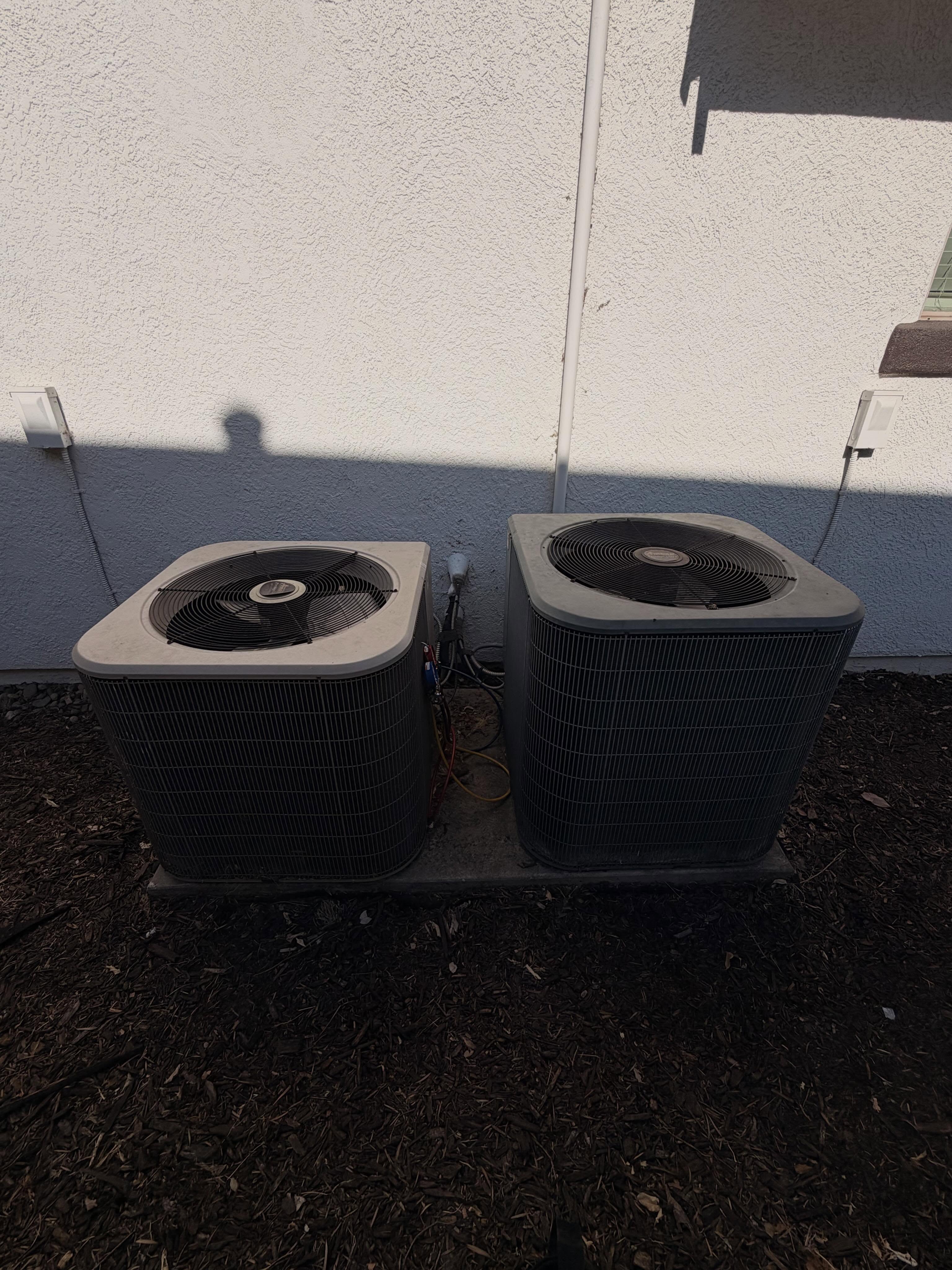
In attached homes, outdoor units are often packed close together in side yards or on pads behind the building, with little room for airflow. Recirculated hot air between neighboring condensers can raise head pressure on a 100°F day. Sometimes the repair includes clearing space around the unit as well as replacing a part.
What happens on an Auburn AC repair visit
The technician confirms the complaint at the thermostat, then checks the filter and the return before going outside. At the condenser, they measure voltage and amperage, test the capacitor and contactor, and inspect the coil. If the electrical side checks out, they connect gauges and compare pressures and temperatures with what the equipment should show for that day's outdoor temperature. Indoors, they look at the coil, the drain pan and the condensate line, and check the temperature split across the coil.
You hear the finding before any part is replaced. A capacitor, contactor or drain clearing is usually done on the same visit when the part is on the truck. A compressor, a coil or a leak search can take a return trip, and we explain why.
When an Auburn AC is worth repairing
There is no fixed rule, but a few thresholds come up again and again. A failed capacitor, contactor, fan motor or clogged drain on a system of almost any age is normally worth repairing. A compressor failure, a leaking indoor coil or a second major refrigerant leak on a system older than about 15 years usually is not, especially on R-22. Auburn's long, hot summers put more run hours on equipment than a coastal climate does, so the age at which replacement makes sense can come a little sooner here. Our regional equipment lifespan guide covers typical ranges.
When replacement wins, the choice between another central AC and a heat pump is open. See the Auburn heat pump installation page for that comparison, or the general AC repair service page for what we repair on every brand. We also handle AC repair in Meadow Vista and AC repair in Newcastle, and the Auburn service area page covers everything else we do in town.