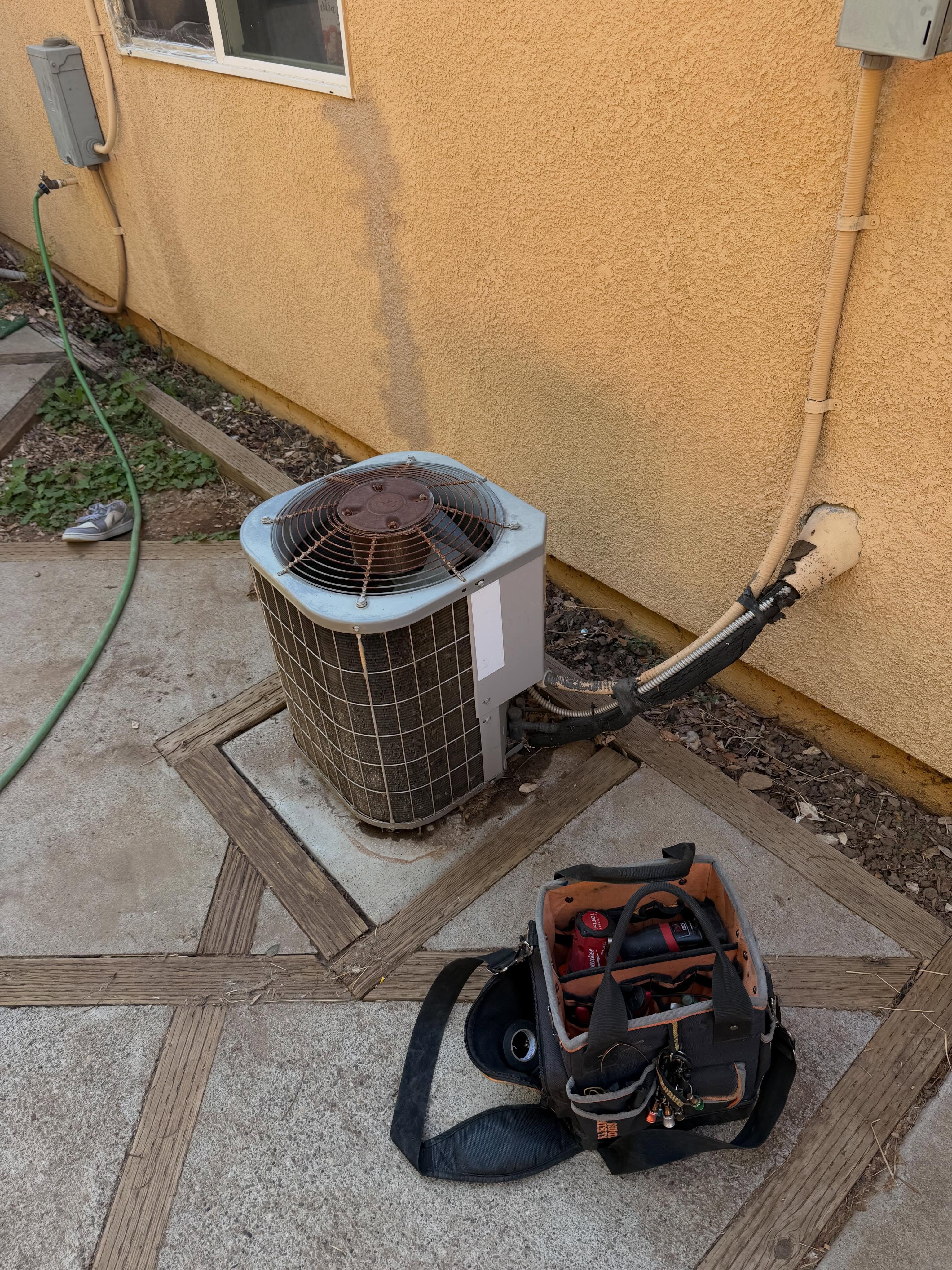
AC Installation in Elk Grove · 7 sections
- 01Where new AC installations happen in Elk Grove
- 02Designing for the space, not the square footage
- 03Ducted, ductless or a heat pump that also heats
- 04Why a new install in Elk Grove is often a heat pump
- 05Electrical capacity and outdoor unit placement
- 06Permits for new cooling in Elk Grove
- 07Getting started
Where new AC installations happen in Elk Grove
Installation is different from replacement. A replacement swaps an existing system; an installation adds cooling to space that has none, or creates a new system alongside an existing one. In Elk Grove, the projects we see fall into a few recognizable groups.
- Room additions and enclosed patios in Laguna and East Franklin homes, where extending the existing ducts would starve the rest of the house of airflow.
- Backyard ADUs and converted garages, which need their own conditioning and often their own thermostat and electrical circuit.
- Older homes near Old Town and in pre-1980 neighborhoods, where a house that predates the suburban boom may never have had a ducted central system.
- Shops, studios and guest houses on Rural Area parcels, where the General Plan's roughly 5,265-acre Rural Area and two-acre minimum lots leave room for detached buildings.
- Upstairs bonus rooms that the original single system never cooled well, where a dedicated second system can be easier than reworking the main ducts.
Designing for the space, not the square footage
A space with no existing system gives you no old nameplate to copy, which is an advantage. The design starts with a room-by-room heat-gain calculation that accounts for orientation, glass, insulation and how the space will be used. That matters in Elk Grove, where NOAA's 1991–2020 normals for Sacramento Executive Airport show roughly 76 days a year at or above 90°F and 14 at or above 100°F. A west-facing ADU with a low-slope roof and big sliding doors can carry a cooling load far out of proportion to its floor area.
Converted garages are a common trap. The slab is uninsulated, the walls may have been framed for storage rather than living space, and the big door opening has often been filled in with a window. Our Manual J guide explains why a calculation, rather than a tons-per-square-foot shortcut, keeps a small space from being drastically oversized.
Ducted, ductless or a heat pump that also heats
The right system type depends on where the space is and what already serves the house.
| Situation | Usually the best fit | Why |
|---|---|---|
| Detached ADU or Rural Area shop | Ductless mini-split heat pump | No ducts to build; heats and cools; one outdoor unit can serve one or several rooms |
| Garage conversion attached to the house | Ductless head, or a small ducted unit if the attic allows | Main system rarely has spare capacity for it |
| Pre-1980 home with no central air | Ducted heat pump or a ducted AC with a new furnace | Whole-house distribution; needs new duct design and return paths |
| Hot upstairs bonus room | Dedicated ductless head or second small system | Avoids rebalancing the entire original duct layout |
Why a new install in Elk Grove is often a heat pump
A space that needs cooling also needs heat, and a heat pump provides both. Elk Grove's winter is mild: the same NOAA normals show an average January low of 39.2°F and only about 15 nights a year at or below freezing, a range modern heat pumps handle well. In SMUD territory there is an added consideration, because SMUD's heat pump rebates apply when a home converts from gas heat or upgrades existing electric heat. Whether a specific ADU or addition qualifies depends on the program terms on SMUD's heating and cooling rebates page, which also requires a SMUD Contractor Network installer. See our SMUD rebate guide and the Elk Grove heat pump installation page.
For detached buildings and single rooms, our guide to mini-splits for ADUs, garages and additions covers layout options, and ductless vs. central ducted compares the two approaches for a whole house.
Electrical capacity and outdoor unit placement
New cooling adds load to the electrical panel, and that is where many Elk Grove installs get more involved. Homes built in the 1990s and 2000s typically have panels sized for the original equipment and appliances, so an extra condenser, an ADU subpanel or a new circuit to a detached shop may need a load calculation and sometimes a panel upgrade. Older Old Town homes may have smaller services still.
Placement matters too. Tract lots in Laguna Ridge and East Franklin often have narrow side yards with setbacks to the property line, a gas meter or a neighbor's bedroom window nearby. On Rural Area acreage the issue is the reverse: long line-set runs from the house to an outbuilding, and trenching for power. Our panel requirements guide covers the electrical side.
Permits for new cooling in Elk Grove
Elk Grove's minor permit list includes mini-split installations, which can be submitted online through eTRAKiT. A new ducted central system that is not a same-location replacement follows a fuller submittal through the Building Safety, Inspection and Permits division, and an ADU or addition carries its own building permit with the HVAC included in that scope. The city has enforced the 2025 California codes since January 1, 2026.
New ducts are where the Energy Code bites hardest. Under the 2025 Building Energy Efficiency Standards, newly installed duct systems must meet insulation and leakage requirements and are typically verified by a third-party rater. Our duct leakage test guide explains what the rater measures.
Getting started
A site visit establishes the load, the electrical picture and the permit path. The cost calculator gives a rough range in advance, and the general AC installation service page describes our scope. If the house already has central air and only needs it replaced, the Elk Grove AC replacement page is the better fit. For nearby cities, see AC installation in Citrus Heights and AC installation in Sacramento, or return to the Elk Grove overview.