Orangevale HVAC guide · 8 sections
- 01No city hall: who handles what for an Orangevale home
- 02Older, owner-occupied and mostly detached: Orangevale's houses by the numbers
- 03What 1950s–1970s Orangevale houses usually need
- 04Fireplaces, wood stoves and the county's burn rules
- 05Permits for Orangevale: Sacramento County, mostly online
- 06Heat pumps, SMUD rebates and the Orangevale climate
- 07Orangevale service pages
- 08Where we work in Orangevale, and how to pick a contractor
No city hall: who handles what for an Orangevale home
Orangevale is a census-designated place of 35,569 people (2020 census) spread over about 11.6 square miles. Because it isn't incorporated, homeowners sometimes call the wrong office. For anything touching heating and cooling, this is the map:
| Need | Who handles it in Orangevale | Notes |
|---|---|---|
| HVAC permit and inspection | Sacramento County Building Permits & Inspection Division | Online through the county's Accela portal; Building Assistance Center at 9800 Goethe Road |
| Electricity | SMUD | Makes SMUD heat pump rebates available |
| Natural gas | PG&E | Gas safety calls and gas service |
| Fireplace and wood-stove rules | Sac Metro Air District | Check Before You Burn, November 1 through end of February |
| Contractor license check | Contractors State License Board | Look for an active C-20 |
Older, owner-occupied and mostly detached: Orangevale's houses by the numbers
Orangevale started as the Orange Vale Colony on part of the 1844 Rancho San Juan land grant, a rural area of orange groves and olive orchards in the rolling hills below the Sierra foothills. Development came in waves, and the housing data shows a broader age spread than most of the county. Per the Census Bureau's 2020–2024 American Community Survey, summarized by Census Reporter, the community has 14,184 housing units with a median year built of 1976.
Three numbers stand out. First, 31.8% of units were built before 1970, including 13.2% in the 1950s and 15.3% in the 1960s; that's a much bigger pre-1970 share than in Folsom. Second, 80.9% of units are single-family detached houses. Third, 75.5% of occupied homes are owner-occupied, so most HVAC decisions are made by the people who live with the result and plan to stay.
Heating fuel is more mixed than people expect. Utility gas heats 59.3% of occupied homes and electricity 37.4%. Another 1.8% use bottled, tank or LP gas, and 0.6% burn wood as their main heat. For a contractor, that means arriving without assumptions: the same street can have a gas furnace, an electric furnace with heat strips, a heat pump and a propane tank.
Long ownership also shapes the equipment. A household that has been in the same house for decades has often replaced the outdoor unit after a summer failure and the furnace after a winter one, each time with whatever was quickest. The result is a system whose parts were never chosen together. When the next major component fails, it is worth pricing the indoor and outdoor sides as a matched set, and our Sacramento HVAC lifespan guide gives realistic service-life ranges for each piece.
What 1950s–1970s Orangevale houses usually need
Many homes from those decades weren't built with central air, or they got it later through whatever space the house allowed. When we look at an older Orangevale home, the questions tend to be the same ones:
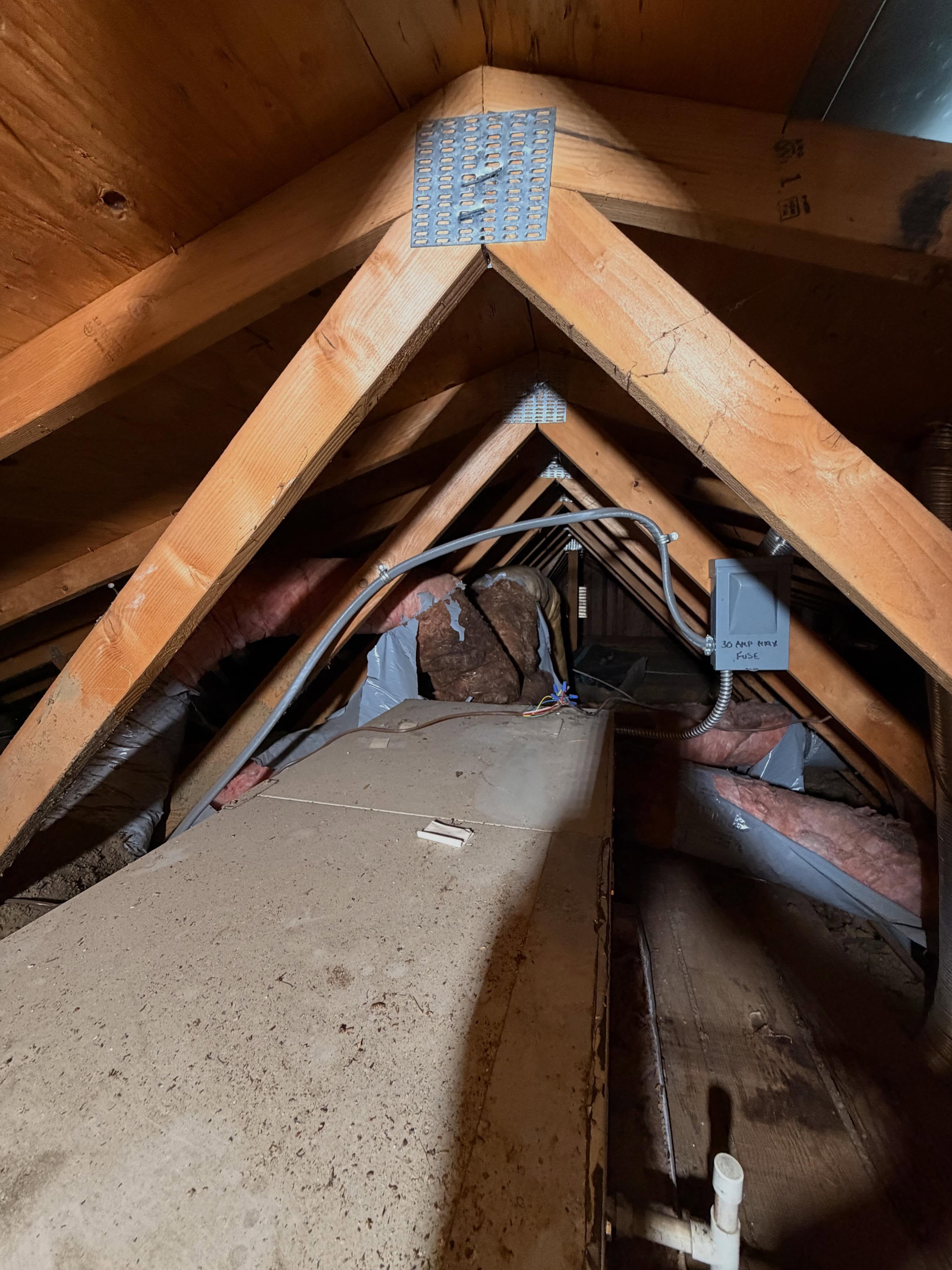
- Where can ducts go? Older houses may have shallow attics, crawlspaces or ducts added to an existing heating system that were never sized for cooling. The answer decides whether a ducted system, a ductless system or a mix is practical. The ductless mini-split guide covers the no-duct option.
- Is the electrical service big enough? A heat pump with backup strips can be a sizable new load on an older panel. That is often the first thing we check before quoting an all-electric system.
- How leaky is the existing duct system? Duct leakage in attics and crawlspaces costs comfort in both seasons; the duct leakage test guide explains how it's measured.
- Has the house been remodeled? Additions, converted garages and enclosed patios change the load, so the original tonnage is a poor guide. Our Manual J guide explains why we calculate it.
Fireplaces, wood stoves and the county's burn rules
Orangevale's rural past still shows in how some homes heat: 0.6% of occupied homes report wood as their main heating fuel, against 0.1% in Folsom, per the same Census tables. Sac Metro Air District's Check Before You Burn rule (Rule 421) applies to unincorporated Sacramento County, including Orangevale, from November 1 through the end of February. On a Stage 1 day, burning is illegal unless you use an EPA-certified insert or stove, or a pellet stove, that emits no visible smoke. On a Stage 2 day, burning any solid fuel in any device is prohibited. A first violation carries a $50 penalty, or the option of a wood smoke awareness exam.
The district's fireplace rules add a second constraint: under Rule 417, traditional open-hearth fireplaces can no longer be sold or installed in Sacramento County, and the rule has barred new permanently installed fireplaces since October 26, 2007. The appliances allowed are EPA Phase II certified wood heaters, pellet heaters, masonry heaters and units the district approves in writing as meeting the EPA particulate standard. When we checked on October 30, 2026, both of the district's wood-stove replacement voucher programs, low-income and general, were listed as closed.
The practical point for HVAC: if a fireplace has been doing part of the heating in your home, the central system may be undersized or in poor shape without anyone noticing. On a no-burn night in January, the furnace or heat pump has to carry the whole house. If yours struggles then, that's worth a visit before the next cold snap. Burn-season air quality also makes filtration worth a look; see MERV ratings explained.
Permits for Orangevale: Sacramento County, mostly online
HVAC work in Orangevale is permitted by the Sacramento County Building Permits & Inspection Division, which accepts applications electronically through its Accela Citizen Access portal. The county's permit FAQ lists residential heating and cooling, new install or replacement, among the residential permits that can be issued automatically online once the permit is paid. That keeps the paperwork side of a straight changeout short.
The inspection side still takes scheduling. Inspections are booked online, by phone at (916) 875-5296 or by text, and the county doesn't book specific times. A replacement also has to meet Title 24: an energy compliance form, and in most changeouts third-party HERS verification such as a duct leakage test before final. The CHEERS homeowner page explains how registered HERS forms work. If your contractor says no permit is needed for a furnace or AC swap, that's a red flag; the county's own guidance says replacing a mechanical system requires one.
Heat pumps, SMUD rebates and the Orangevale climate
Orangevale sits at about 240 feet. NOAA's 1991–2020 normals for the Sacramento 5 ESE station, the nearest long-record site, show a 94.4°F average July high and a 41.1°F average January low. That's a climate a properly sized heat pump handles comfortably, and the summer cooling load is the bigger design challenge.
Because Orangevale is on SMUD, the utility's rebates apply. On October 30, 2026, smud.org/HVAC listed $3,000 for a variable-stage or $2,000 for a two-stage heat pump replacing gas heat, and $1,000 for upgrading an existing electric system. Single-stage units don't qualify, the installer must be a participating SMUD Contractor Network contractor, and the job needs a HERS-verified CF3R, so ask any bidder whether they're enrolled. The federal 25C credit ended for equipment placed in service after December 31, 2025, and TECH Clean California's HEEHRA single-family funds were fully reserved as of February 24, 2026. The SMUD rebate guide has the details, and heat pump vs. furnace covers the decision.
Orangevale service pages
Service detail lives on the Orangevale pages: AC repair for aging condensers and coils; AC replacement when a system is worn out or mismatched; AC installation for older homes that never had central air; furnace repair for gas and electric furnaces; furnace replacement for homes staying with gas; and heat pump installation for all-electric or dual-fuel setups.
Where we work in Orangevale, and how to pick a contractor
Orangevale is a single ZIP code, 95662, bordered by Citrus Heights to the west, Folsom to the east, Fair Oaks to the south and Placer County to the north. We work throughout it, from the older streets along Chestnut, Orangevale, Main and Walnut Avenues, where some of the colony's original olive trees still stand, to the neighborhoods around Orangevale Community Park. Nearby hubs include Folsom, Citrus Heights and Granite Bay, and the full list is on the Sacramento County page.
When comparing bids for an Orangevale home:
- Verify the license. Use the CSLB license check and confirm an active C-20. Statewide HVAC holds CSLB #1023360 (C-20 and C-43 Sheet Metal), licensed since 2017.
- Confirm the county permit. The bid should say the contractor will pull the Sacramento County permit and arrange the HERS verification.
- Ask what they checked. In a 1950s or 1960s house, a good bid mentions the panel, duct condition and where any new ducts would run.
- Account for every heat source. If you use a fireplace, stove or propane, tell the contractor so the new system is sized to heat the house on its own.
- For a rough range first, use the cost calculator. To book a visit, use the contact page or call (916) 461-3405.