AC Repair in Sacramento · 7 sections
- 01A long cooling season wears parts out, not just one hot week
- 02What tends to fail, by the age of the house
- 03The R-22 question in East Sacramento, Land Park and older tracts
- 04How a Sacramento AC repair visit runs
- 05Repairs in rented homes
- 06When a repair stops making sense
- 07SMUD peak hours and how they affect what you notice
A long cooling season wears parts out, not just one hot week
Cooling demand in the city is measured in months. NOAA's 1991–2020 normals for the Sacramento 5 ESE station show about 1,576 cooling degree days a year, with July and August alone accounting for roughly 780 of them. The same normals count about 158 days a year that reach 80°F or warmer, which means a compressor in a Sacramento backyard may start cycling in May and keep going into October.
That calendar shapes what breaks. Run capacitors and contactors fail from accumulated heat and cycling rather than from a single bad day. Condenser fan motors wear their bearings dry over several seasons. Indoor coils in attic air handlers sit in superheated air all summer. Most of the repairs we make in the city trace back to that cumulative load, which is why a system that limped through last September often fails outright in June. Our capacitor and contactor guide explains the most common of these electrical failures.
What tends to fail, by the age of the house
Census figures for the city split the housing stock into five roughly comparable eras, and each one brings its own repair pattern. The table is a starting point, not a diagnosis.
| Era of home | Typical cooling setup | Repairs we see most |
|---|---|---|
| Before 1940 (about 23,000 units) | Central air added decades after construction, or none at all | Undersized returns starving the coil, frozen evaporators, cramped condenser placement along side yards |
| 1940–1959 (about 40,400 units) | Retrofitted split systems, some still on R-22 | Slow refrigerant leaks on older equipment, disconnected attic ducts, failing compressors |
| 1960–1979 (about 50,400 units) | Second or third condenser on original ducts | Capacitor and contactor failures, mismatched coils from past partial swaps |
| 1980–1999 (about 49,000 units) | R-22 or early R-410A systems nearing end of life | Compressor wear, coil leaks, rusted cabinets and condensate pans |
| 2000 or later (about 49,600 units) | Builder-installed R-410A, often in attics | Clogged condensate lines, blower and control board faults, upstairs comfort complaints |
The R-22 question in East Sacramento, Land Park and older tracts
Homes with equipment installed before 2010 may still run on R-22. The EPA's Class II phaseout schedule ended production and import of new R-22 on January 1, 2020, so servicing those systems now depends on recovered or reclaimed supply. A small electrical repair on an R-22 unit is still often worth doing. A leak that needs a full recharge usually isn't, and we'll tell you that before adding refrigerant.
In neighborhoods with older stock, such as Land Park, Curtis Park and East Sacramento, the R-22 condenser is frequently paired with a furnace that is also decades old. That combination is where a repair call most often becomes a replacement conversation, covered on our Sacramento AC replacement page. Our refrigerant leak decision guide walks through the math in general terms.
How a Sacramento AC repair visit runs
We start with what you noticed: when it stopped cooling, whether the outdoor unit is humming or silent, whether water showed up in the hallway ceiling or garage. Then the technician works through the system in order.
- Power and controls. Thermostat call, low-voltage fuse, disconnect, breaker and contactor. A Sacramento summer afternoon is when a weak capacitor finally fails to start the compressor.
- Airflow. Filter, blower, return grille sizing and the evaporator coil face. Ice on the suction line usually points here or to low charge; see our frozen coil guide.
- Refrigerant circuit. Pressures, superheat and subcooling compared with the manufacturer's targets, then a leak search if the numbers say charge is low.
- Condensate. Attic air handlers in two-story homes rely on a drain line and often a secondary pan or float switch. A tripped float switch looks like a dead AC; our condensate leak guide covers it.
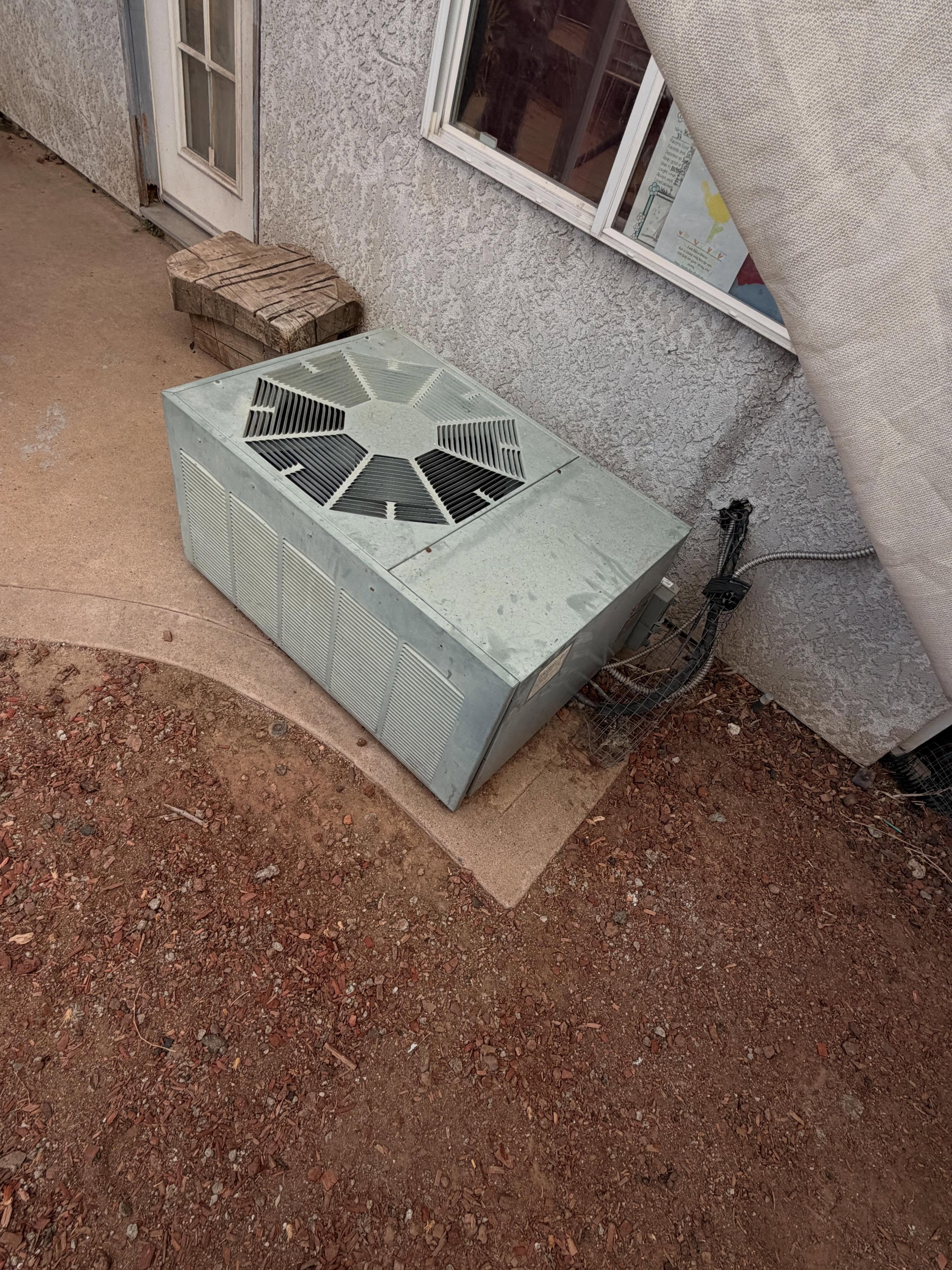
- Outdoor coil. Cottonwood fluff, grass clippings and dust packed into the fins raise head pressure on hot days.
Repairs in rented homes
Close to half of the city's occupied homes are rented, according to Census data, so a good share of AC calls involve a tenant who lives with the system and an owner who pays for it. We can meet whoever has access, but the repair decision belongs to the owner or property manager. If you're a tenant, it helps to send the owner the model and serial numbers from the outdoor unit's label before the visit. For duplexes and fourplexes with one condenser per unit, we check each system separately, since sharing a wall doesn't mean the units share a problem.
When a repair stops making sense
We don't use a price formula, but a few situations usually tip the answer toward replacement in Sacramento homes:
- A failed compressor on a system in its mid-teens or older, especially in the 1980s–1990s housing where original equipment is now long past its expected life. Our Sacramento lifespan guide discusses typical ages in this heat.
- A leaking indoor coil on an R-22 system, where repairing the coil still leaves a recharge with scarce refrigerant.
- Repeated summer breakdowns combined with rooms that never cool, which points to sizing or ductwork rather than a single part.
- A gas furnace that is also near the end of its life. Replacing both at once opens the option of a heat pump, which can qualify for SMUD's gas-to-electric rebate. See our Sacramento heat pump installation page.
SMUD peak hours and how they affect what you notice
SMUD's Time-of-Day rate makes 5 p.m. to 8 p.m. on weekdays the expensive window, and SMUD's own tip is to set the thermostat to 78°F or higher in summer. Many households now pre-cool before 5 p.m. and let the house drift up through the evening. That habit is fine, but it can hide a weak system: if the house never recovers after 8 p.m., or the AC runs all afternoon without pulling the temperature down, that is worth a diagnostic visit rather than a rate adjustment.
Rooms that are always hotter than the rest of the house are a separate issue from a failed part. In older homes, they usually trace to ducts or returns; in newer two-story homes, to attic heat and supply runs. Our guide to why an AC isn't cooling helps sort out which kind of problem you have.
For more on how we approach air conditioning work in general, see our main AC repair service page. For the rest of the city's housing, utilities and permits, see the Sacramento HVAC overview. We also handle AC repair in nearby Arden-Arcade and Elk Grove.